GLOW peptide research under the lens
The longer the benefit list, the more I want the experimental particulars. These are the ones that make the blend look less simple.
TB-500 borrows a longer protein's results
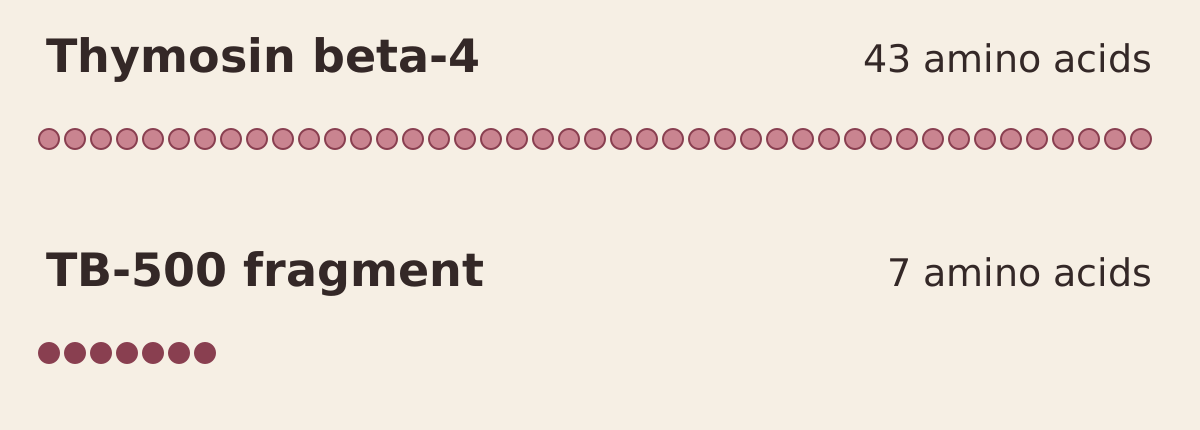
The TB-500 problem comes before any debate over whether the result was impressive. TB-500 is a 7-amino-acid fragment; thymosin beta-4 is a 43-amino-acid peptide. The names travel together, but the 1999 wound experiment by Malinda and colleagues tested full-length thymosin beta-4 in rats.
In that experiment, re-epithelialization—the new skin cover growing across a wound—increased by 42% over saline controls at day 4 and 61% at day 7. The wounds also contracted more and showed greater collagen deposition and new-vessel growth. Those measurements seem admirably specific to me. The result is about rat wounds and the parent peptide, however, not human recovery with the TB-500 fragment or GLOW peptide blend.
There is human work on the parent, too. A placebo-controlled Phase 1 study in 40 healthy volunteers found full-length thymosin beta-4 well tolerated, with infrequent mild-to-moderate adverse events and no serious adverse events. Phase 1 is an early safety test, not proof that it heals injuries. Neither paper establishes that the fragment reproduces the parent's behaviour.
A fully transected rat Achilles tendon
In the 2003 BPC-157 Achilles study, researchers fully transected the tendons of Wistar rats. Healing improved across biomechanical, functional, microscopic and macroscopic measures. Tendon-cell outgrowth also increased in culture. The paper gains weight with me because its outcomes extend beyond an animal merely appearing comfortable.
But it was still a rat experiment with a deliberately created injury. It cannot establish recovery from an everyday human tendon problem, and it tested BPC-157 rather than the blend. The numerical amounts describe that experiment; the dosage page puts them beside the other study amounts without converting them into a human regimen.
The vascular explanation comes from work linking BPC-157 to VEGFR2 activation in chick membranes, rats and human vascular endothelial cells in culture. VEGFR2 helps control angiogenesis, the growth of new blood vessels. The authors found increased receptor expression and activation of the VEGFR2-Akt-eNOS pathway. Human cells in a dish do not turn that into a human clinical result.
GLOW peptide for skin starts with GHK-Cu
The skin case is the least surprising part of GLOW's reputation. The GHK skin-regeneration review describes increased collagen and other supporting material in cell work, alongside reports of improved firmness, elasticity and fine lines with topical GHK-Cu. The tissue-remodelling review also describes elastin and repair-related changes across the literature.
I expected a simpler collagen story. Instead, the literature concerns remodelling: making supporting material, breaking some of it down and recruiting repair cells. That is biologically richer than “more collagen,” but it does not make the injected blend a proven skin treatment. Much of the relevant work concerns topical preparations or cells.
The delivery problem deserves equal billing. A 2025 review of topical GHK identifies poor passage through the stratum corneum, skin's outer barrier, as a central difficulty. It discusses strategies for topical delivery, leaving the injected mixture unanswered. A change in route creates another question to test.
GLOW peptide before and after: a different mixture
The controlled hair-count trial followed 45 men with androgenetic alopecia for 6 months. It tested a topical complex of 5-aminolevulinic acid and GHK. Hair counts increased significantly versus placebo; the study reported no adverse events. It did not test pure GHK-Cu, and it did not test GLOW.
Here the familiar ingredient gets credit the experiment cannot allocate. The result concerns a combined topical preparation. The other active ingredient, topical route and hair-count endpoint define the experiment. Dropping them turns the paper into a different skin-and-recovery story.
Before-and-after photographs of GLOW cannot settle the missing comparison. Nor do they establish a timeline for visible results. The mirror stories describe what people report, while this trial describes a measured outcome from a different preparation.
The combination remains a proposal
The rationale has a certain elegance: GHK-Cu for matrix remodelling, BPC-157 for vascular and protective effects, thymosin-related research for cell movement. Those mechanisms appear in the constituent reviews, vascular experiments and wound work. No study has demonstrated their proposed synergy in the three-part blend.
My preferred next experiment would compare the mixture with its parts and measure a defined outcome in people. A longer list of molecular pathways would not substitute for that comparison. The 2026 review still describes favourable animal results alongside scarce rigorous human safety data. The proposal remains scientifically plausible and clinically unproved.