GLOW peptide dosage: numbers without a blend trial
A printed amount can look settled long before the science is. These are research amounts, not instructions for use.
A neat label, an untested proportion
One commonly cited GLOW peptide label lists 10 mg BPC-157, 10 mg TB-500 and 50 mg GHK-Cu per vial. Those figures state the labelled contents. Clinical research has yet to validate a dose for the mixture. Formulations are not standardized, and there is no controlled human dose study of the three-part blend.
I object to the certainty a ratio can acquire through repetition. The 2026 review of unapproved peptides describes scarce rigorous human safety data; the 2025 BPC-157 review regards that constituent as investigational. Neither turns a blend label into a regimen. There is no research basis here for a human dose recommendation, a schedule or a conversion from animal amounts.
The amounts have different subjects attached
The GHK-Cu skin literature includes fibroblast experiments at 10^-12 to 10^-9 M and topical formulations approximately 0.05% to 2% by weight. Concentration in cell medium and concentration in a cream describe different exposures. Neither establishes a GLOW injection amount.
In the rat Achilles experiment, BPC-157 was studied at 10 microg, 10 ng or 10 pg per kg body weight. These were Wistar rats with fully transected tendons. I read the animal and injury alongside the figure; without them the number has lost its meaning.
The BPC-157 intravenous pilot reported 10 mg followed by 20 mg in two healthy adults. Its purpose was a small safety observation; efficacy and dose-finding for GLOW were outside its scope. The 40-volunteer thymosin beta-4 Phase 1 study tested 42, 140, 420 and 1260 mg intravenously. The preparation was full-length thymosin beta-4. Its amounts cannot establish a regimen for TB-500 or the blend.
A blue solution still leaves questions
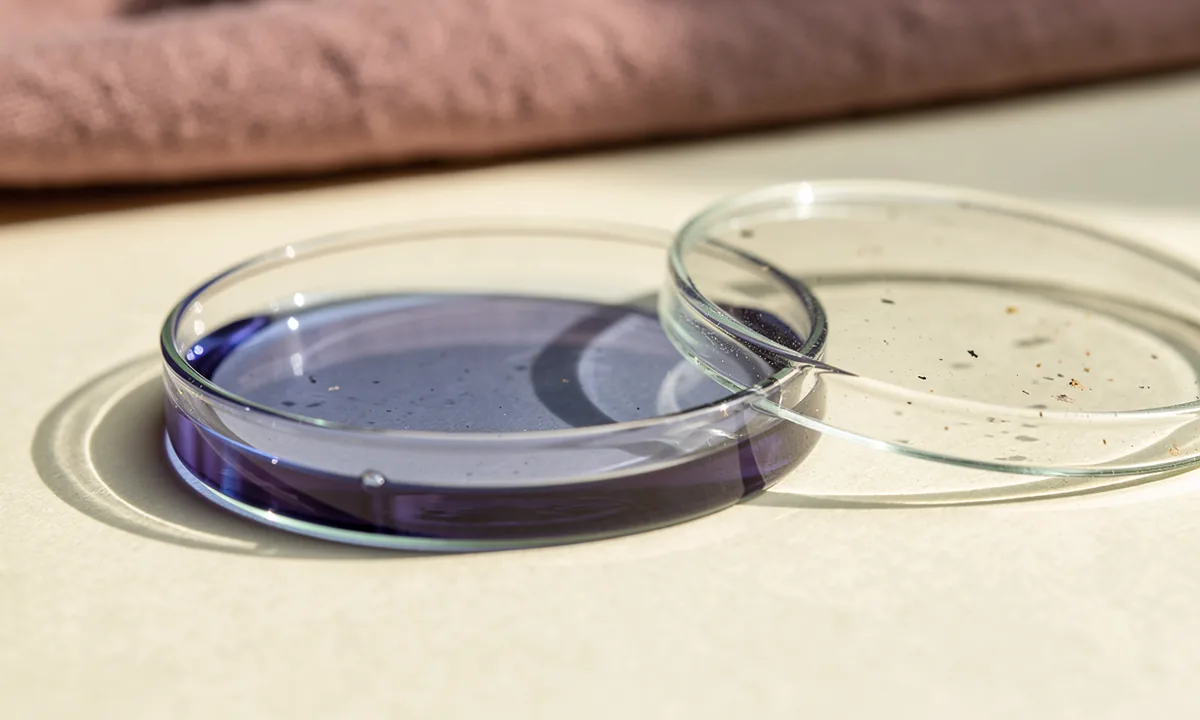
The GHK-Cu copper complex has a blue-violet colour and is most stable near pH 5-6.5. Strong reducing agents and low-pH actives can disrupt it. The GHK-Cu skin review concerns the constituent's chemistry and topical biology; it does not characterize the stability of GLOW after mixing.
I like the chemistry precisely because it refuses to answer a bigger question. A blue liquid cannot establish the identity, purity, sterility or compatibility of the whole mixture. Co-formulating a copper complex with the other peptides raises unresolved questions about pH and copper chemistry.
No standardized reconstitution volume or validated mixing method for GLOW emerges from these studies. Online preparation accounts are anecdotes, not clinical evidence. Neither their procedures nor the colour supplies the missing formulation research.